* Plot spoilers and skimpy loincloths ahead - watch before reading! *
The best screen Tarzan has always been, for me, the legendary Johnny Weissmuller - star of numerous jungle adventures featuring the Edgar Rice Burroughs-penned, vine-swinging hero. It's a close run thing as I also greatly admire the late 60's borderline 'bit trashy' but all round fun guy and gaudily colourful small screen hero - Ron Ely (always a bit too sweaty - or rubbed on-oily, but that's what this new thing called colour TV does to you!).
Ely was a Tarzan who always looked more like the geezer bloke who lives next door to you, come over to fix your dad's car (in a loincloth from the local joke shop) than proper Tarzan, but he was still really knowledgeable and cool - at least through a child's eyes!
 |
| RON ELY - HE CAN FIX YOUR FAN BELT! |
Weissmuller was kind of a real life Tarzan though - an Olympic champion swimmer, he proved an athletic and endearing jungle man and wore the loincloth that god gave him as naturally as a baby wears a nappy; he also did not ever fix your dad's car. He jumped on top of - and wrestled - crocs instead, and chatted up a nearly naked Jane. He also looked like he didn't want to be your friend and far preferred cuddling up to wild animals with big trunks, if not making a treehouse for his jungle mate (the girl lost in jungle kind - not the best mate down t'pub kind that Ely would have taken!). Yes - Weissmuller was proper Tarzan.
The life and times of Johnny Weissmuller may not have been perfect, and he may have craved or been seduced by success too greatly for comfort (he divorced his first wife on the instruction of MGM - to appeal more to the girls that adored his new sexier take on the Tarzan character) but he was never less than convincing when swinging through the trees with his trademark Tarzan yodel and chimp hanging off his shoulders.
In the second Tarzan movie, Tarzan and his Mate (1934) that was just about still pre-Hays Code (which means we got all the naughtier stuff before the powers that wanted to be, and censor film across states, became more enforcing) we even had newly arrived girl about jungle - Jane (Maureen O' Sullivan - doubled by Olympic swimmer Josephine McKim) swimming with Tarzan . . in the nude! Oh yes - believe it! Those black & white pictures may seem tame to modern cinema-goers, but back in the day there was all manner of titillation on display.
Of course the nude Jane scenes were eventually cut after protest from religious groups and in the climate of good taste creeping in across the US states able to make their own decisions on censorship at the time, and only later found and restored to the film at the turn of the century - but at least the extra scenes were never destroyed, as so much snipped material at the time often was.


Eventually MGM decided that Tarzan didn't just need a mate - he needed a boy too. Being the now far more restrictive era of film-making (or rather - film screening) by that point (in which Jane had to now wear far less revealing outfits and a more decent 'one-piece') Tarzan didn't get to 'make' baby. He adopted. And so - 'Boy' (great choice of name!) was born. And he was played by a young Johnny Sheffield in the film Tarzan Finds a Son! (1939) and in subsequent sequels (the best of which being the quite deranged - Tarzan's Desert Mystery, in 1943).
 |
| LIKE FATHER, LIKE . . |
Eventually the film studio decided that Boy had grown a bit too big for his boots, and certainly his loincloth, and he was sent away to school - in England. Hurrah! Now that would have made a great film saga . .
The Tarzan movies had already became increasingly fantastical (brilliantly so - Nazis, giant spiders and mermaids all making cameos) but all good swingers have their day, and Tarzan had also had his. Without Boy or even Jane to perk him up (even MGM had quit and handed the films over to RKO) life up in the trees was a little bit duller for Tarzan, and within a few years Johnny Weissmuller was given his swimming orders. The actor swam across to another film studio (Columbia) to make more Tarzan-like films as rugged wild animal tracker and fully-clothed hero Jungle Jim (1948 - 1954) that finished its life as a TV series (1955/56).
 |
| APE WITH ROCK, WAITS FOR CUE . . |
'Boy' got his own series as well: twelve features within six years as 'Bomba' - teenager of the jungle. It proved to be his final bow in acting, or at the very least - his final swing.
While Weissmuller had ended up post-Tarzan at Columbia and Cheeta the chimp had started work on his autobiography, poor Johnny ended up down 'Poverty Row' - at Monarch Films (one of the super-low budget action movie studios of the day) which meant that 1949's Bomba the Jungle Boy, the first film in the new showcase film series for Sheffield, was shot on a jungle-dressed studio backlot and had a whole film reel's worth of stock jungle footage shoved up its trunk to boost (not entirely unsuccessfully - making stock footage insertion something of a minor artform here) the exotic jungle boy vibe.

The script from Jack DeWitt (later best known for the Richard Harris ritualistic, sympathetic Sioux classic - A Man Called Horse from 1970, and a couple of sequels) isn't terrific, but does the job. It all starts off with a father and daughter-led photography team travelling on location to Africa (which is more than Monarch Films allowed Bomba!) to shoot (with a camera - not a shotgun, although . .) the exotic local wildlife.
Meet the supporting players: there's intrepid, and slightly devious, grumpy old dad - George Harland (played by horror regular Onslow Stevens from the pleasingly ghastly delights of House of Dracula, The Creeper and giant ant-terror - Them!) and his even pluckier, fiery but doe-eyed daughter Pat (Peggy Ann Garner who had already been praised at a very young age for such films as Jane Eyre and A Tree Grows in Brooklyn).
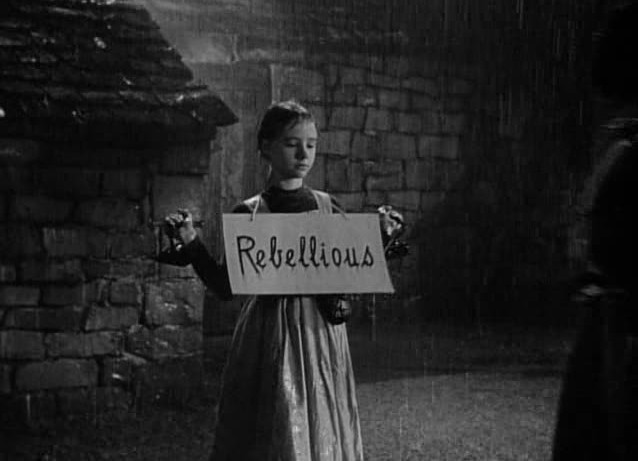 |
| JANE EYRE (1943) |
Father and daughter are shown around the parts of the jungle that other tourists can't reach by a resident glorified 'Scottish' gamekeeper (well, with an accent like that . . !) called Andy (played by Irish supporting player Charles Irwin who had numerous 'uncredited' roles in famous movies from 'Tin Polisher' in The Wizard of Oz to 'Cardiff Police Constable' in Frankenstein Meets the Wolf Man ). And then there's enigmatic character actor Smoki Witfield on board as the resourceful and loyal local chap - Eli (and like Andy, our favourite 'Scottish' gamekeeper - a recurring role in the Bomba films).
Pat gets lost in the jungle while chasing wildlife, but never looks all that scared, in fact quiet Pat soon turns into a plucky and brave, lagoon-swimming, dress-shedding, b-movie adventuress by the time the tribal drumbeat of the end credits kicks in. Pat, even before meeting up with Bomba, has already tried her best to persuade dad to let her join him in capturing those ever more dangerous-to-shoot photographs of wild beasts (that they spend most of the film looking for - in ever increasing circles around the well-dressed studio backlot).

Dad is bored of all the usual kind of wild jungle beasts they encounter on their shoots (on that old familiar stock footage - and who can blame him?) and wants to capture something really unusual. He also doesn't want his daughter going with him into any properly dangerous places - like the mysterious faraway matte painting of her father's favourite rocky (and completely forbidden to all teenage daughters) danger zone seen on the distant horizon where great danger may lurk (or just 'Boy' from the Tarzan movies).
Of course, his daughter goes walkabout, nearly gets eaten alive by a stuffed leopard, is saved by a boy in a loincloth who fights and kills the stuffed leopard and then runs off after she tries to shoot him. It's not long before she also ends up in the forbidden zone that Daddy forbade her to go near as well (Sigmund Freud - take note!). Her punishment: a swarm of killer locusts. Ok, say what you like about this film and its scathingly low budget, but it sure is a heady trip when it wants to be!
 |
| Tarzan love Jane - Bomba love all girls! |
Luckily for everyone, especially those still missing Boy from the old Tarzan films, Pat is soon rescued by Bomba the Ape Teen, who - luckily for her - is about the same age (if dressed in less clothing). Pat, in a violent rage of symbolic teenage hormonal angst, tries to shoot Bomba when he gets too close.
To make up for this unfriendly welcome (in yet another rage of symbolic teenage hormonal angst) she later decides to take off all her clothes behind a nearby bush. Bomba watches with interest - he's already nobly offered the girl his only loincloth and been rejected. Pat then changes into the handy and rather fetching Jungle Jane bikini kit that Bomba has made - for just such an occasion as this. Not surprisingly, it's a perfect fit and Bomba saves the day! The End. Oh hang on - that's not the end . .

In a rush of even more symbolic, but middle-aged, testosterone-fuelled paternal rage, when nice boy Bomba goes and tells the half-dressed girl's father that he has 'rescued his daughter' and is keeping her safe 'in his treehouse' - daddy shoots Bomba as payback (and this time doesn't miss).
With the odd savage lion attack to come (or more like a native tribe's attack on a poor defenceless lion as part of a crop-saving ritual - this film is clearly not vegan-friendly) as well as the aforementioned deadly locust swarm (and that's about it for the action stuff) we have to get our thrills more from Pat and Bomba taking a swim in the river together (but unlike the original Weissmuller/ O'Sullivan 'Tarzan and Jane' swim - everyone keeps their loincloths on this time). 'Bomba the Jungle Boy' keeps it simple on a limited budget and doesn't do much to raise the stakes, but it does try to get some decent momentum going, when it can afford to.
And if you were a teenage groupie of Tarzan-type movies back in the day - then Boy sure has grown up since playing chase with Cheeta in the treehouse while Tarzan 'make love - not war' with Jane in the lagoon, and there was probably some curiosity factor at the time in seeing what the former child star was up to these days. And these days, Boy's in love! It's all very innocent love and entirely unchallenging stuff of course, but still ridiculously endearing somehow and well-played by Sheffield and Peggy Ann Morgan.

I wonder if Sheffield made for a worthy, if a bit bric-a-brac, pin-up for bedroom walls across America before James Dean came along and did Rebel Without a Cause in 1955 and cool quiffs replaced crappy loincloths. Bomba doesn't have any annoying parents to bug with his bad behaviour but he does run wild on his own, and is a confirmed loner. He's always a bit too well-behaved, if a bit prone to sulking, to be a genuine rebel though, but does still make a stand for rebellion against untrustworthy adults, attacks the hunter and protects their prey, and when offered the chance to return to civilization at the end of Bomba, the Jungle Boy - he refuses.

And here lies the main theme at the heart of this film, above all the lion and locus attacks: will moody teenager Pat stay in the jungle with Bomba and become the next Maureen O'Sullivan? Will Bomba go to New York and become king of the urban jungle? Will there be another Bomba movie? Well, the answer was yes to more Bomba films as this one had been a huge success. The other exciting plot spoiler (what Pat does) I will let you find out for yourself . .
It's easy to gently mock a film clearly designed for a more youthful audience than the grown-up Tarzans were. The Bomba films were the Twilight vampire flicks of the jungle film world and Johnny Sheffield the Robert Pattinson of his day (I'm just guessing this really: is it more likely that young filmgoers at the time, like many critics of these films today, also thought Bomba was a little bit second rate to the big budget Tarzans; a bit too worthy and the lead now dressed in a bit too big a loincloth to care?).
 |
| "I like you Bomba, but I'd rather be saved by Tarzan!" |
As directed by veteran action and TV serial director Ford Beebe (Buck Rogers/ Flash Gordon/ The Green Hornet) this Bomba debut always moves along at a brisk pace, but it is a bit too talky for its own good. The chatter is broken up by being blended with huge chunks of stock location footage, although the end result is far more seamless than you may expect - in fact, while not being entirely convincing, and occasionally not at all convincing, it's still pretty neat that the stock footage doesn't kill the film outright but keeps it holding on for dear life when there's barely a decent plot to cling on to.
The script vine being swung on here is well and truly greased with long spells of aimless chatter and the actors have to work their safari hats (or loincloths) off to get to the good stuff (or at least a bit better stuff). The editors on this movie (Roy Livingston and Otho Lovering) also deserve a medal, if not an Oscar - the film's dramatic finale, in which the main cast watch a lion hunt and are surrounded by a whole pack of the wild beasties out to eat them alive, relies almost entirely on stock footage for its kicks.
This stock footage occasionally may appear rather dubious to a modern day audience, especially one lingered-on killing of a lion by tribal leaders that can make for uncomfortable viewing. But this scratchy footage is seemingly filmed by documentary makers at the time and from some respectful distance and not (as far as it's possible to tell) for the purposes of entertainment (unlike the kind of self-shot footage some Italian zombie filmmakers in the 70s especially, allowed - resulting in an often increasing burdening of guilt in the years ahead, as public consciousness changed and grew increasingly outraged).
 |
WHERE'S BOMBA WHEN YOU NEED HIM?
'CANNIBAL HOLOCAUST' SHOCKS IN 1980 . . |
The Bomba films often have our hero protecting wildlife and appearing devastated when he has to kill another animal to protect the stupid tourists from certain death. In Safari Drums (1953) Bomba has to kill a lion to stop it suffering further, after a member of a visiting film crew deliberately shoots it, mortally wounding the King of the Jungle.

Bomba reveals how the animals all listen to him and respect him - even converse with him, but now he will be their prey as he has killed one of their own. When Bomba says that: 'Remember - if you kill one of them, the rest will trample you to death', it's hard not to feel a slight shiver shooting down your spine! The film's finale lingers on a real fight between a lion and a tiger, and far more consciously exploits animals for our entertainment than anything seen in Bomba the Jungle Boy.

Some other startling wildlife footage edited into Jungle Drums was originally used memorably in the first Bomba: a lion creeps up on a warthog (I've been told, although to me it looks more like some creature out of Doctor Who - I mean, what the hell is that thing?) minding its own business and then plucks it out of its resting hole in the ground like it's a person-sized, newly-shaven rag doll. It's astounding, even quite upsetting footage, and stays in the mind long after the film has finished. But that's the reality of nature and the wild: often naturally raw and brutal when played as a code of survival.
 |
| EASY TIGER! |
The supporting cast in Bomba, the Jungle Boy are especially effective, despite few lines of much worth to work with. Onslow Stevens as Pat's caring but oppressive father and Charles Irwin as their friendly guide and gamekeeper (and warner of imminent stock footage danger) are often a joy to watch: exchanging dire warnings and thinly-veiled threats to each other to do things 'my way - or not at all'! The sparky patter does get a bit repetitive and isn't consistently endearing, if only because there's so bloody much of it - the cast do their best.

Sheffield as Bomba is striking of body frame and really looks the part. Ok, his hair may be a little too heavily blowdried to entirely convince as a wild child of the jungle but his toned muscles will still cause certain bulge envy or appreciation in watching males sunk on a sofa worrying about their waistline and the lord of the chattering chimp's hesitant words of jungle wisdom are endearingly coy and refreshingly self-conscious.
Sheffield's accent here veers between that of a shy young New Yorker lost on a low budget film backlot and a feisty jungle man putting on his best baritone for the Jungle Janes in the audience: it's a strange combination and in later films he drops the hesitant Tarzan-style monotone yap. But this is a star turn, and Sheffield probably knows it - you can imagine all the girls sittng with their families at the original theatrical screenings going all weak at the knees, and others of all ages and all persuasions feeling much the same way, but with less of a fanfare back in the days of the Hays Code restricting all minds of most impure thoughts!

There's a lot of humour to be had between Bomba and Pat, especially the now rather infamous scene where Pat tears her nice (but entirely impractical) dress strolling around Bomba's jungle hideout that teasingly reveals the top of her stockings. Bomba offers his loincloth and starts to untie it (they're saying bum di di bum di di bum bum bum) then brings Pat the perfectly stitched leopard print dress that he keeps out back (one would feel so much safer with a strong, fearless man beside one). Jane goes behind the hut to change, throwing her underwear to the nearby chimps as she does - who all get to try on her knickers (I wonder if we'll ever get to seven?).
And if you are wondering about all those random quotes scattered around just now - it's my tribute to 1970's Carry on Up the Jungle (with Terry Scott as a plumper than your average Tarzan star) that this Bomba sequence reminded me of, and way before Terry's time in the loincloth!
 |
| BOMBA & PAT |
 |
| UGH & JUNE |
It's pretty racy, this first ever Bomba movie, for the time. You can almost imagine the filmmakers sniggering off camera. Peggy Ann Garner who plays Pat, was well known to filmgoers as an enigmatic former child star (she was only 13 when she starred in her most famous film - A Tree Grows in Brooklyn, in 1945) and her mildly saucy jungle antics in Bomba a few years later may have raised a few eyebrows at the time, if only because her previous work had been far more serious and startling than appearing in a (very) b-movie jungle actioner with another former child star beside her.
And Peggy Ann steals the show with her seething need to rebel and escape her mundane life (if being an exotic wildlife photographer travelling around the world can ever be called 'mundane'!). There's some real moral dilemma-raising in Pat's uncertainty at the end of the movie as to whether to stay with Bomba lost in the jungle and leave her father - forever wondering what became of her.
Clearly Pat wants a life alone with Bomba, and the boy himself also clearly believes there's enough space for her back in his hut (maybe they could even adopt a baby one day - just like Tarzan did with 'Boy'!) or should she go back home to America to help with her father's rather naive idea to 'make a fortune' with slow-mo film footage of animals which he decides schools: 'will pay a fortune for'. Ah - bless his cotton socks! (Cue: lots of footage of animals jumping through the jungle like hairy ballerinas in slow-mo to prove how amazing this footage could be. And I do mean lots . .)

The young actress imbues her character with steely-eyed, butter wouldn't melt, (but could bubble and flame if you don't watch out) charisma. Bomba is smitten. As he waits to find out whether Pat will stay in or leave the jungle in the film's final moments, there's real edginess and impending fear of regret shining through his brooding gaze as an over-protective father tries to tilt the balance.
Peggy Ann Garner's career never really topped her iconic performances in favourites like A Tree Grows in Brooklyn or Jane Eyre and soon shifted into mostly TV work after her Bomba role, and she died young - at 52 - of cancer.

After the Bomba films reached the end of their jungle road in 1945, Johnny Sheffield tossed his loincloth into the flames of the past and never acted again. He's still far better remembered as Tarzan's playful, mischievous - but fiercely loyal - 'Boy', but Bomba was his chance at a starring role, and even though he is still upstaged at times in his debut by a pretty girl ripping her dress and a whole load of stock footage, without Johnny there would have been no Bomba. And without Bomba there'd be no more use for stock footage of lions being chased by tribal leaders in the long grass. Instead, that footage will have, by now, rotted away.
The Bomba books were written by a team of writers (the same team that gave us the Hardy Boys and Nancy Drew) called the Stratemeyer Syndicate (created and initially written mainly by Edward Stratemeyer) under the pseudonym of Roy Rockwood. These stories fired the imagination of younger readers and later spawned a series of comic books as well as the films.

In older age, Johnny Sheffield, pruning a tree at home in California, slipped and fell - in 2010. The fall wasn't thought serious at first, but it triggered a fatal heart attack and he died aged 79. The irony of Sheffield, the former 'Boy' and 'Bomba' of the jungle, being up a tree when he lost his footing (something he never did on camera) probably wasn't lost on anyone. The accident was a tragic end card to have for such a well-loved child star and who was a continually warm and generous recipient of fan adoration throughout his life - talking and writing about those jungle epics of the past with huge affection.
Johnny Sheffield never really hit the big time, second playing to a tall man in a loincloth, a skinny-dipping Jane, or random - but thrilling, to audiences of the day - stock wildlife footage. A pilot for a new TV series created for him by his father that was to be called 'Bantu the Zebra Boy' only reached pilot stage. Sheffield's career in the movies was over.
 |
| LOOK - ZEBRA PRINT LOINCLOTH! |
Johnny Sheffield remained, as close contemporary James Dean would remain too - a forever youthful genre icon in cinema history (Johnny just a bit less famous than some of the others!). This was an actor who had spent most of his career swinging aimlessly and joyously through the trees, saving - and then chatting up - lost American girls in danger in the deepest jungle without ever so much as a farewell kiss in thanks, or forever having a bloody scene-stealing chimp swinging around his neck in just about every damn film he appeared in: respect is due!
 Bomba's two year bask in the b-row spotlight was relatively brief but still full of broody, sulky, jungle angst and charm. And he was certainly a decent enough rival, if not quite to Tarzan, then certainly to Jungle Jim . .
WORDS: MARK GORDON PALMER


